
Behaviorism is a psychological school of thought which had its beginning in the early 20th century that focuses on observable behaviours rather than internal events like cognitive processing and emotion. Behaviorism asserts that all behaviour is acquired through conditioning. This conditioning can be further classified into either classical (Pavlov) or operant (Thorndike, Skinner).
Key Researchers
Ivan Pavlov (1849 – 1936)
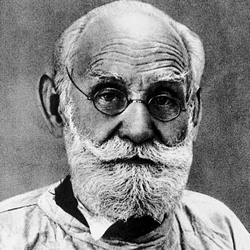
Ivan Pavlov was a distinguished Russian physiologist. He is most renowned for introducing the concept of the conditioned reflex, a cornerstone in the field of behavioural psychology. His groundbreaking research not only advanced our understanding of conditioned reflexes and their relation to the nervous system but also earned him international acclaim, culminating in the Nobel Prize for Physiology or Medicine in 1904 for his work on digestive secretions.
Pavlov’s work laid the foundational principles for behaviourism and remains integral to contemporary psychology and educational theories.
Edward Thorndike (1874 – 1949)

Edward Thorndike, widely regarded as a pivotal figure in the establishment of contemporary educational psychology, gained prominence through his notable puzzle box studies involving cats. These experiments were instrumental in formulating the law of effect.
According to Thorndike’s theory, behaviours that are promptly met with favourable outcomes tend to be repeated. Conversely, the law of effect posits that actions resulting in displeasure or discomfort are less prone to be repeated. This is known as the “law of effect”.
John B. Watson (1878 – 1958)

John B. Watson is believed by many to be the father of the behaviorist movement, although this is contested by some. Hi seminal article, “Psychology as the Behaviorist Views It”, is seen by many as the founding flag in the ground of the behaviorist movement.
Watson is also known for the Little Albert experiment, in which he demonstrated that a child could be conditioned to fear a previously neutral stimulus. His research further revealed that this fear could be generalized to other similar objects.
B.F. Skinner (1904 – 1990)

B.F. Skinner was a highly influential American psychologist, one of the leading figures in the development of behaviorism, and is best known for his work on operant conditioning
Skinner’s most notable discoveries or contributions to the field of psychology include:
- The operant conditioning process (Skinner’s theory of learning)
- The notion of schedules of reinforcement
- Introduction of response rates as a dependent variable in research
- The creation of the cumulative recorder to track response rates
Robert Gagné (1916 – 2002)

Robert Gagné was an educational psychologist who is best known for his theory on the conditions of learning and on the nine events of instruction.
Throughout his professional life, Gagné concentrated on deliberate learning—learning that happens within educational settings or training sessions. His theory of instruction has become a staple in the domain of instructional design and remains a significant influence on the educational technology sector, evidenced by the ongoing references to Gagné’s contributions in leading educational publications.
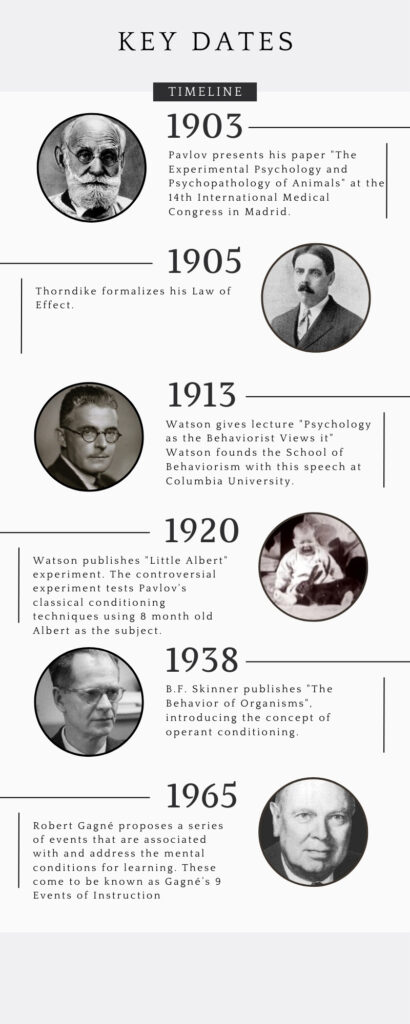
Key Dates
Infographic (click to expand)
Discussion | What are the implications of behaviorism for instructional design?
Behaviorism, with its focus on observable behaviors and the conditions under which they occur, has significantly influenced instructional design, shaping how educators approach teaching and learning. The implications can be seen in several key aspects:
Structured Learning Environments
Behaviorism suggests that learning environments should be structured in a way that observable behaviors can be measured and controlled. Instructional designers, therefore, can create learning environments that are predictable and controlled, where stimuli can be presented in a systematic manner to elicit desired responses.
Behavioral Objectives
A fundamental aspect of behaviorist-influenced instructional design is the emphasis on specific, measurable, and observable learning objectives. These objectives clearly define what learners should be able to do after a learning intervention, making it easier to measure learning outcomes against predetermined criteria.
Reinforcement and Feedback
Behaviorism highlights the importance of reinforcement (positive or negative) in learning. Instructional designs often incorporate immediate feedback mechanisms to reinforce desired behaviors and correct undesired ones. This can include positive reinforcement for correct responses (e.g., praise, rewards) and corrective feedback for incorrect responses, to guide learners towards the desired outcome.
Opinion
Behaviorism is often dismissed as outdated by today’s instructional design standards. To do so without interrogating the strengths and weaknesses of behaviorist theory within an educational context would be premature. Let’s start off by exploring the common weaknesses levelled against it:
Overemphasis on observable behavior
By focusing solely on the observable behavior we run the risk of neglecting the internal cognitive processes involved in learning. This can limit the understanding and application of deeper cognitive skills. This would be in direct contrast to popular cognitive learning theories such as Bloom’s Taxonomy.
Reductionist approach
Behaviorism is often criticized for the reductionist approach it takes, simplifying learning to stimulus-response mechanisms.
Limited scope for higher-order thinking
The emphasis on memorization and specific responses may not foster higher-order thinking skills such as the analysis, evaluation, and synthesis of knowledge. These are crucial for complex learning and understanding to take place.
While the case against behaviorism may seem damning, it is important to remember that behaviorism does possess some strengths, such as:
Clarity of objectives
Behaviorism emphasizes clear, observable, and measurable learning objectives. This clarity benefits both teacher and student by ensuring that the expected outcomes are understood and met.
Structured learning environment
By controlling the environment and stimuli, educators can more effectively guide the students towards the desired learning outcomes.
Skill acquisition
Behaviorism is particularly effective for teaching specific skills and behaviors. Drill and practice, repetition, and reinforcement schedules are effective strategies for mastering basic skills that serve as building blocks.
Designed Learning Experience
Objective
To teach learners new vocabulary and grammar rules in a foreign language.
Stimulus
The e-learning platform presents a series of interactive exercises designed as games. Each game is structured to introduce new words or grammar concepts in a visually engaging and contextually rich environment. The stimulus here is the visual presentation of the object along with the list of possible words.
Observable Behavior (Response)
The desired response is the correct identification of the word that matches the image. When learners select the correct word, they proceed to the next item; if they choose incorrectly, they receive immediate feedback and an explanation before repeating the attempt.
Positive Reinforcement
Upon choosing the correct word, learners receive immediate positive feedback, such as a congratulatory message, points added to their score, or a visual representation of progress (e.g., a progress bar filling up). This positive reinforcement encourages the repetition of the correct behavior, reinforcing the learning.
Negative Reinforcement
Negative reinforcement is applied to encourage avoiding incorrect responses. For example, after a wrong answer, the system might temporarily lock the learner out of progressing to more advanced lessons, requiring them to review the current material. This isn’t a punishment per se but a mechanism to reinforce the importance of mastering current content before moving on. The removal of the lockout (an aversive condition) once the learner demonstrates understanding serves as negative reinforcement, motivating them to avoid future mistakes.
Observation of Learning
Learning is observed through the learners’ ability to correctly match words with images. The rate of progress through the activity, along with the decrease in errors over time, serves as a measurable indicator of learning. The application of both positive and negative reinforcements ensures that learners remain engaged and motivated throughout the learning process, with behaviorism principles guiding the design and delivery of content to promote effective learning outcomes.